Trying to choose between a townhouse and a condo on the Upper East Side? In 10022, that decision is rarely about status. Both can offer a premier Manhattan address. The real question is how you want to live, what level of control you want, and how you want your costs and responsibilities structured over time. Let’s break it down.
Upper East Side Basics
On the Upper East Side, buyers are often comparing homes across very different micro-markets. The neighborhood’s core luxury corridors include Fifth, Park, Madison, and Lexington avenues, along with the surrounding side streets. In practice, a few blocks can change your daily routine, your building style, and your ownership experience.
Condo inventory is much broader than townhouse inventory. Current Upper East Side condo examples range from about $525,000 for a studio to roughly $25.77 million for a penthouse. By contrast, current house and townhouse listings span from about $5.999 million to $49.995 million, with far fewer options available.
That difference matters. If you want more choice at a wider range of price points, condos usually give you more to compare. If you want something rarer and more customized, a townhouse may be the better fit.
Condo Living on the Upper East Side
A condo offers a more structured ownership model. In New York, condo owners own their individual unit outright and share ownership of the building’s common elements. You also pay common charges, follow board rules, and may encounter resale or leasing restrictions depending on the building.
For many buyers, the appeal is convenience. On the Upper East Side, high-end condo buildings often come with the service package luxury buyers expect. Current examples at buildings like 900 Park Avenue and 1049 Fifth Avenue include offerings such as 24-hour doorman service, concierge, resident management, garage access, and fitness-related amenities.
That setup can make condo ownership feel more streamlined day to day. You are generally relying on a building structure to handle many shared operations, rather than coordinating everything yourself. If your priority is ease, predictability, and service, this model can be very attractive.
What a condo often suits best
A condo may be a strong fit if you want:
- A wider selection of homes on the Upper East Side
- Shared services such as doorman or concierge support
- A more standardized ownership structure
- Less direct responsibility for building-wide upkeep
- A residence that may be simpler to manage on a daily basis
Townhouse Living on the Upper East Side
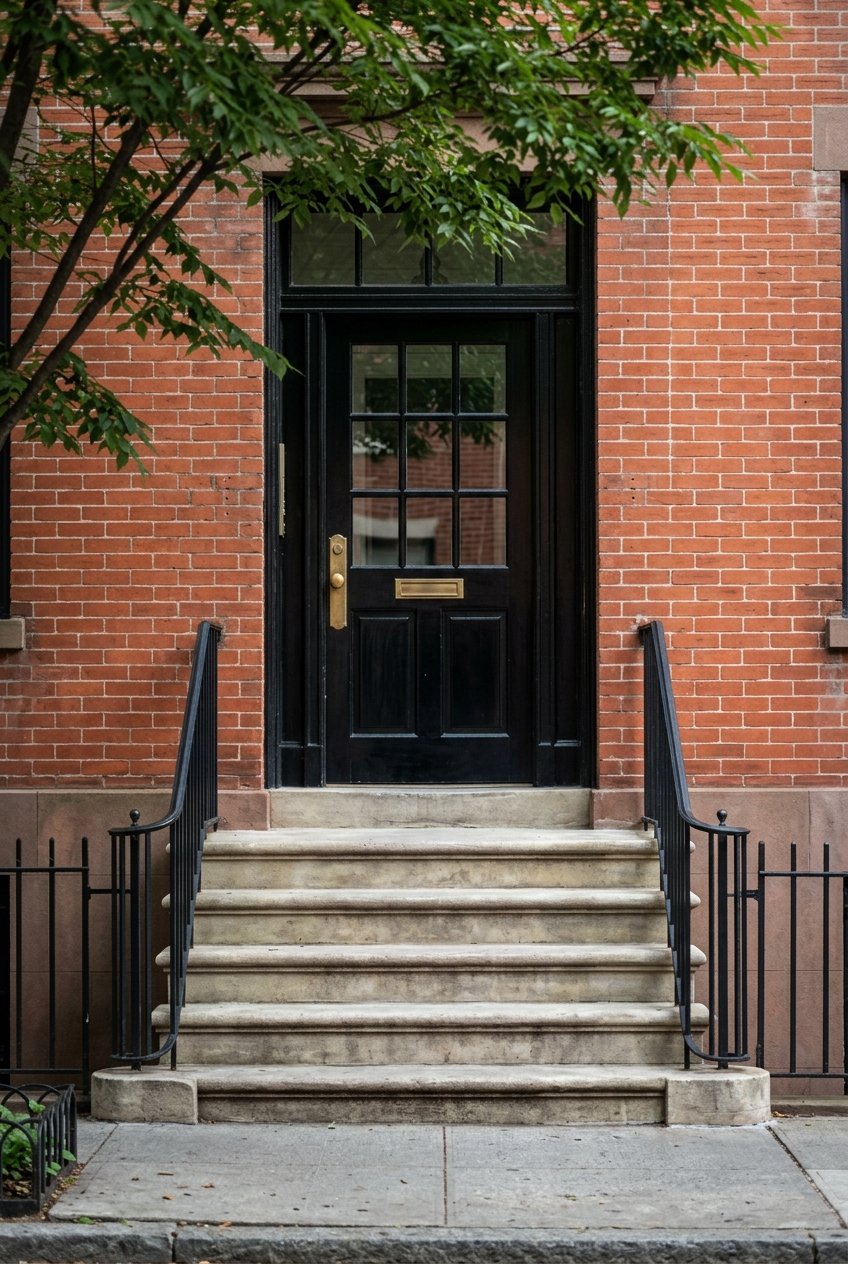
A townhouse usually offers the opposite tradeoff. You are buying greater privacy, more direct control, and a more independent ownership experience. Instead of operating within a shared building structure, you are typically managing a single property under one deeded ownership structure.
That independence is a major draw for many Upper East Side buyers. A townhouse can feel more personal, more flexible, and more enduring. On blocks where landmarked architecture and classic city fabric define the streetscape, that ownership experience can be part of the appeal.
The tradeoff is responsibility. With a townhouse, you generally take on more upkeep directly rather than spreading those costs through common charges and building operations. For buyers who value autonomy, that can be worthwhile. For buyers who want more support built into the ownership model, it may feel like added complexity.
What a townhouse often suits best
A townhouse may be a strong fit if you want:
- More privacy and separation from neighbors
- Greater control over the property
- A single-asset ownership structure
- A home that may better match long-term legacy planning goals
- A rarer and more bespoke Upper East Side purchase
Price Ranges: What You Can Expect
On the Upper East Side, both condos and townhouses can reach trophy-level pricing. The difference is not whether one category is premium and the other is not. The difference is how much product exists in each category and how pricing tends to behave.
Current condo asking prices on prime corridors show a broad range. At 900 Park Avenue, active condo listings are currently shown from $2.495 million to $7.5 million. At 1049 Fifth Avenue, there is an active $13.5 million penthouse listing. At 1122 Madison Avenue, current listings range from $6.75 million to $89.5 million, with other active offerings at $21.175 million and $38.75 million.
Townhouse inventory is thinner and pricing is more customized. Current Upper East Side townhouse and house examples include listings at $7.85 million, $9.8 million, $9.995 million, $12.99 million, $13.4 million, $15.9 million, $17.5 million, $19.5 million, $23.9 million, $24.5 million, $25.75 million, $34 million, and $46 million. That range reflects how rare and block-specific these properties can be.
Carrying Costs Can Change the Decision
For many buyers, the real difference between a townhouse and a condo shows up after closing. Monthly and annual carrying costs can shape how comfortable ownership feels over time.
With a condo, projected common charges, taxes, and carrying costs must be disclosed in the offering plan. That creates a more structured fee environment, though buildings may also have rules and assessments. The benefit is that many operating expenses are shared through the building.
With a townhouse, many of those costs are carried more directly by the owner. Property tax structure may differ as well. New York City classifies most one- to three-family houses as Class 1 property, while condominiums are generally Class 2, and the Department of Finance calculates taxes under different assessment rules for each class.
For tax year 2026, New York City lists a Class 1 tax rate of 19.843 percent and a Class 2 rate of 12.439 percent. Still, the nominal rate alone does not tell you what your actual bill will be, because the assessment rules differ by class. That is one reason carrying-cost analysis should be specific to the exact property, not just the property type.
Closing Costs Matter at Upper East Side Price Points
On the Upper East Side, many purchases cross tax thresholds that meaningfully affect closing costs. New York State imposes a 1 percent mansion tax on residential purchases of $1 million or more. At these price points, that cost is often part of the baseline conversation.
New York City also imposes a base real property transfer tax of 1.425 percent up to $500,000 and 2.625 percent above $500,000 for most residential transfers. Additional state transfer taxes apply at the $2 million and $3 million thresholds in New York City. In broad terms, buyers usually pay the mansion tax, while sellers usually pay the NYC base transfer tax.
Lifestyle: Service Versus Control
If you strip away the labels, this decision often comes down to service versus control. A condo typically offers a more managed environment, with building staff, common systems, and a clearer operating framework. That can be ideal if you want a polished ownership experience with fewer day-to-day logistics.
A townhouse usually offers more independence. You may have more privacy, more control over how the property is used, and a stronger sense of owning a standalone asset. For some buyers, that autonomy is worth the added responsibility.
Neither option is inherently better. The better option is the one that matches your priorities, schedule, and long-term plans.
Location Still Shapes the Experience
On the Upper East Side, location can matter as much as property type. Buyers looking west often focus on access to Central Park, which runs from Fifth Avenue to Central Park West between 59th and 110th Streets and includes zip code 10022 in its service area. For many, that proximity is a major daily amenity.
Farther east, other park options may shape the lifestyle more directly. Carl Schurz Park sits from East End Avenue to the East River between East 84th and East 90th Streets, and the East River Esplanade runs from East 90th Street to the RFK Bridge. Depending on where you spend your time, those outdoor spaces may matter more than a building amenity package.
School access is also address-based, not condo-versus-townhouse based. NYC Public Schools directs families to use their home address in MySchools or related search tools to identify zoned schools. In other words, when this factor matters to your search, the exact address is what you need to evaluate.
Which Option Fits Your Goals?
If you want broad inventory, strong service, and a more standardized ownership model, a condo may be the more practical choice. It can be especially appealing if you value convenience, staff support, and easier day-to-day management.
If you want privacy, autonomy, and an asset that may align with long-horizon ownership, a townhouse may stand out. On the Upper East Side, that can mean buying into a rarer category of property with a more bespoke ownership experience.
The key is to compare beyond the asking price. You want to look at carrying costs, governance, daily routine, park access, and how long you expect to hold the property. In a neighborhood where a condo on Park Avenue and a townhouse a few blocks away can offer equally compelling prestige, the smarter decision usually comes down to fit.
If you are weighing this choice on the Upper East Side, strategic guidance matters. The right comparison is never just condo versus townhouse. It is this condo versus that townhouse, on this block, with these costs, under this ownership structure. For a confidential, highly personalized discussion, connect with Kathy Kaye.
FAQs
What is the main difference between a townhouse and a condo on the Upper East Side?
- A townhouse usually offers more privacy and control, while a condo usually offers more shared services, amenities, and building governance.
Are condos or townhouses more expensive on the Upper East Side?
- Both can be very expensive, but condos offer a broader range of inventory and price points, while townhouses are rarer and often priced more individually.
Do Upper East Side condos have more monthly fees than townhouses?
- Condos usually include common charges and shared building costs, while townhouse owners often handle more upkeep directly rather than through building-wide fees.
Does school zoning depend on choosing a condo or townhouse on the Upper East Side?
- No. NYC Public Schools bases school access on the property address, not on whether the home is a condo or a townhouse.
Are closing costs high for Upper East Side condo and townhouse purchases?
- They can be significant, especially because many purchases meet the $1 million threshold for New York State’s mansion tax and may also trigger other transfer-related taxes.